AUDIO TO MIDI / CHECKING FINE TUNING
Audio to MIDI for a detuned melody
A matching note name does not confirm matching tuning. Check the actual MIDI before replacing a slightly sharp recording.
Measured answer. Our reference and +35-cent melodies produced identical MIDI files: C4, E4, G4 and C5, with no pitch-bend events. The fine offset did not survive in these exports. This is a synthetic pair, not a test of a singer.
Two melodies, separated by a small tuning offset
We generated C4, E4, G4 and C5 reference tones, nominal MIDI keys 60, 64, 67 and 72. Their programmed starts are 0, 0.6, 1.2 and 1.8 seconds. Each tone lasts 0.4 seconds, with 0.02-second fades at both ends and silence between tones. Both complete files last 2.4 seconds.
The second WAV uses the same schedule, amplitude parameter of 0.33 and reset phase for each tone. Only the frequency formula changes: f = 440 × 2^((key − 69) ÷ 12) × 2^(cents ÷ 1200). We supply cents = 0 for the reference and cents = 35 for the other file. The 440-Hz value is our chosen tuning reference, not something detected from a performer.
Each input has 52,920 mono frames at 22,050 samples per second, stored as 16-bit PCM in a 105,884-byte WAV. Duration follows directly: 52,920 ÷ 22,050 = 2.4 seconds. Rebuilding the public generator reproduced both original hashes exactly. The files differ in their audio samples; no original MIDI instructions were supplied to the detector.
Verify the offset in the saved WAV bytes
We independently read each WAV's integer PCM samples. Within each tone, we examined the central 0.05–0.35-second window relative to its programmed start, excluding the fades. We located each negative-to-positive zero crossing, linearly interpolating its frame position between the adjacent samples. Frequency equals (crossing count − 1) × sample rate ÷ (last crossing position − first crossing position). The JSON retains every crossing and all window boundaries.
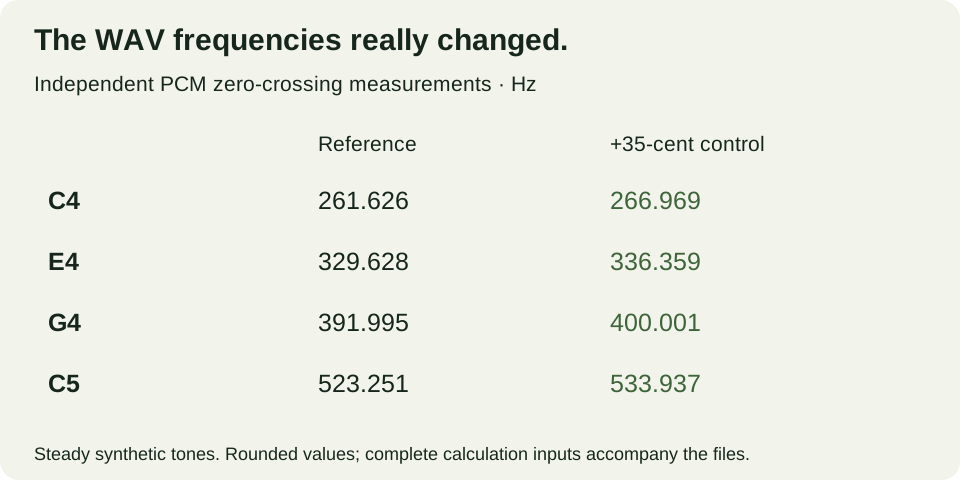
The four reference measurements are approximately 261.626, 329.628, 391.995 and 523.251 Hz. The detuned values are 266.969, 336.359, 400.001 and 533.937 Hz. For each pair, the measured offset is 1200 × log2(detuned frequency ÷ reference frequency). Rounded to three decimals, all four offsets are +35.000 cents. This checks the constructed steady tones; it is not a general-purpose tuner evaluation or a measurement of perceived pitch.
C4 · key 60
- Reference WAV
- 261.626 Hz
- Detuned WAV
- 266.969 Hz
- Both MIDI files
- C4 no pitch bend
E4 · key 64
- Reference WAV
- 329.628 Hz
- Detuned WAV
- 336.359 Hz
- Both MIDI files
- E4 no pitch bend
G4 · key 67
- Reference WAV
- 391.995 Hz
- Detuned WAV
- 400.001 Hz
- Both MIDI files
- G4 no pitch bend
C5 · key 72
- Reference WAV
- 523.251 Hz
- Detuned WAV
- 533.937 Hz
- Both MIDI files
- C5 no pitch bend
Convert each recording separately
On 9 November 2026, we selected each original WAV in the live WAV-to-MIDI converter in Chrome. Export tempo was 120 BPM and the final-release estimate was enabled. Selecting the detuned file cleared the earlier draft before the second conversion.
We clicked each generated download link, saved its actual MIDI and parsed the files independently with Ruby. We compared the complete file bytes as well as individual note and channel events. This did not involve a DAW, an external synthesizer or a competitor conversion. The current converter source is available separately from the observed results.
Different audio became the same MIDI instructions
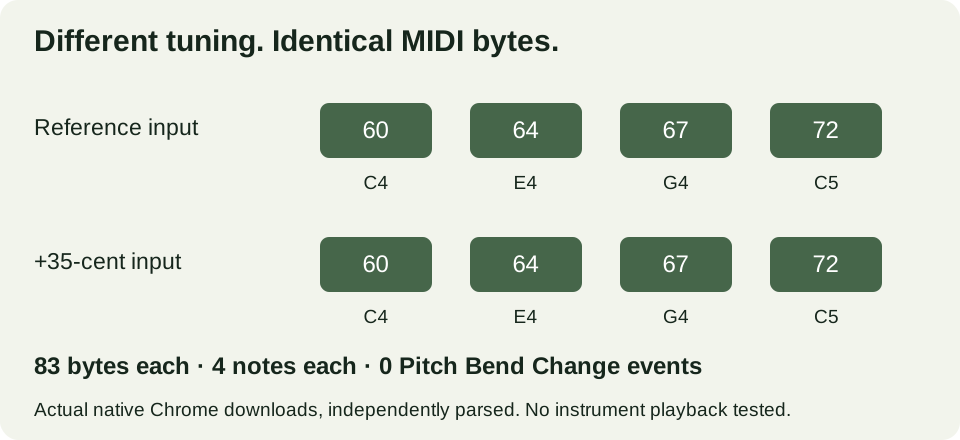
Both downloads are 83-byte, format-0 Standard MIDI Files with one track and 480 ticks per quarter note. Their complete bytes are identical. Each contains the four note numbers 60, 64, 67 and 72, with velocity 88. Neither contains a Pitch Bend Change channel message. The raw record includes every parsed channel event rather than inferring bend data from the displayed note names.
That full-byte equality is the decisive observation in this pair: the two different source tunings produced no difference in the saved instructions. The +35-cent source offset was therefore not represented by this export. We do not infer a recovered tuning from four correct pitch-class labels. Conversely, identical MIDI files do not guarantee the same sound on two differently configured receiving instruments.
This is a finer change than the integer-note transposition check. There we changed the intended note keys. Here the nominal key sequence stays fixed while each source oscillator moves by the programmed fraction of a semitone. These are separate editing questions, even when a piano roll shows the same four note rows.
The same note sequence still needs a timing review
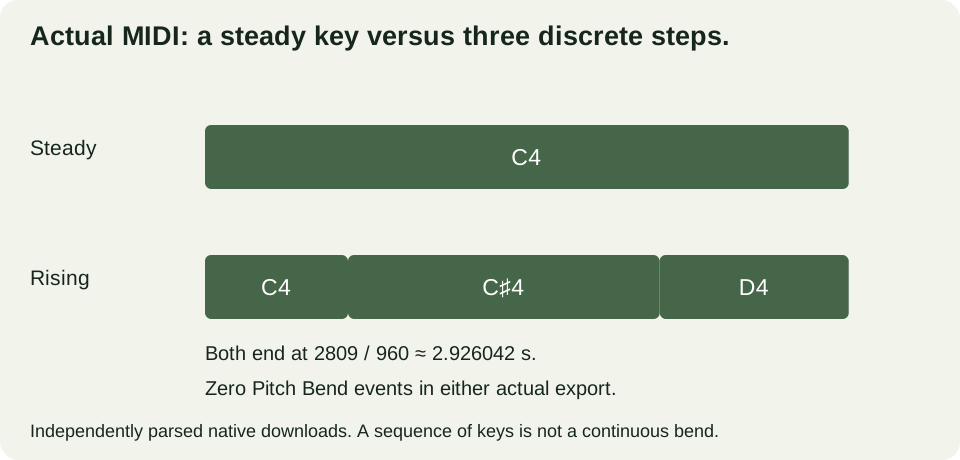
Both files have one 500,000-microsecond tempo event, the selected 120 BPM. Seconds equal tick ÷ 480 × 500,000 ÷ 1,000,000, or tick ÷ 960. Their starts are ticks 0, 490, 1070 and 1627; their ends are 401, 981, 1560 and 2140. The table gives the parsed times, rounded to six decimals.
| Note | Input start (s) | Output start (ticks) | Output start (s) | Output end (s) |
|---|---|---|---|---|
| C4 | 0.0 | 0 | 0.000000 | 0.417708 |
| E4 | 0.6 | 490 | 0.510417 | 1.021875 |
| G4 | 1.2 | 1070 | 1.114583 | 1.625000 |
| C5 | 1.8 | 1627 | 1.694792 | 2.229167 |
For E4, the actual start is 490 ÷ 960 ≈ 0.510417 seconds. Its difference from the programmed 0.6-second start is 490 ÷ 960 − 0.6 ≈ −0.089583 seconds. For the final C5, the ending difference is 2140 ÷ 960 − 2.2 ≈ +0.029167 seconds. The 2.2-second input ending includes the generated fade. These are file-relative comparisons with programmed tone windows, not a performer's attack or a universal latency correction.
Note keys and fine tuning carry different information
The MIDI Association's message summary describes the note number in Note On and a separate Pitch Bend Change message. Bend response depends on the receiver's sensitivity. A note key alone therefore does not document a recovered cent offset, and a bend number without its receiving configuration does not establish an audible interval.
Keep the recording beside the draft
Save the first MIDI unchanged. If you need the original tuning, preserve the source audio as a reference instead of relying only on its note labels.
Check the instrument you will actually use
Review its tuning and bend settings before drawing conclusions from playback. This experiment did not measure a target instrument's reference pitch or bend range.
Make fine adjustments deliberately
If you decide to recreate a source offset, audition the change with that instrument. Treat it as an editing decision. A global adjustment will not by itself reproduce a phrase whose tuning changes over time; that case was not tested here.
Watch the fine-tuning check
Compare the original tuning offset with the byte-identical MIDI exports and their absent Pitch Bend events.
Download the exact inputs and actual outputs
Both WAVs are original synthesized controls. Each MIDI is the file actually saved from its corresponding production conversion.
Reference tuning
Programmed cents = 0, using our 440-Hz reference.
Reference input WAV Actual reference MIDIOffset tuning
The same schedule, programmed +35 cents throughout.
Detuned input WAV Actual detuned MIDIAll PCM measurements, MIDI events, hashes and formulas · Rebuild both original WAVs
A question before replacing a slightly sharp part
If the note names match, did the fine tuning survive?
Editorial question. Our pair shows why that check is insufficient. The source WAV frequencies differ by the programmed +35 cents, verified independently from their samples. Their downloaded MIDI files are byte-identical and contain no pitch-bend events. The labels match while the fine offset is absent from these exports. This result applies to these controls, not every converter or every detuned performance.
Limits of this check
We tested two short, isolated, constant-frequency sine melodies in one Chrome session with one export configuration. We did not test vibrato, changing intonation, chords, microtonal instruments or acoustic recordings. We measured saved PCM and MIDI instructions, not listener perception or a receiving synthesizer. The experiment establishes what these files contain and leaves those other outcomes unmeasured.
Start with the full audio-to-MIDI tutorial for the workflow. The separate checks for loud and soft accents and changes of tempo inspect different information in the draft.