AUDIO TO MIDI / CONTINUOUS PITCH
Audio to MIDI for a sliding pitch
Check whether a smooth slide survived as pitch movement or became separate keys.
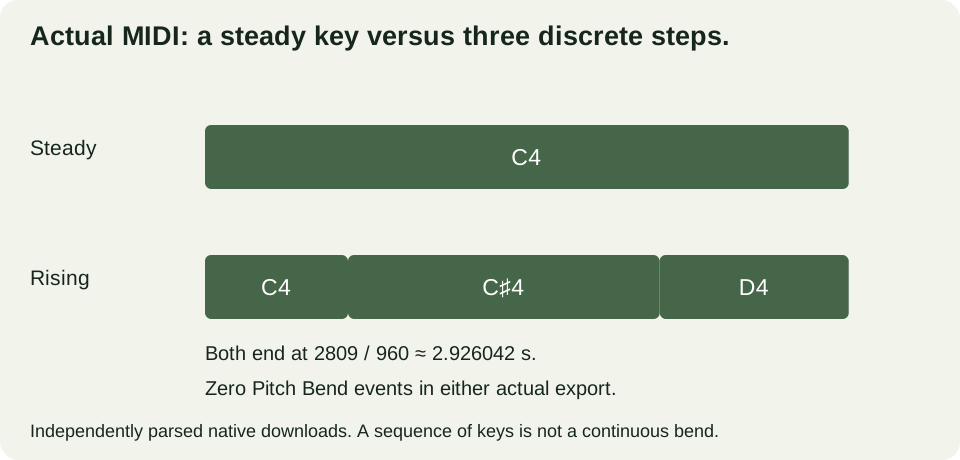
Measured answer. Our rising tone became C4, C♯4 and D4 in the actual MIDI, with no Pitch Bend events. The steady control became one C4. The slide's direction survived as three keys; its continuous movement did not remain encoded. These are two synthetic inputs, not a voice or instrument accuracy test.
One steady tone and one uninterrupted rise
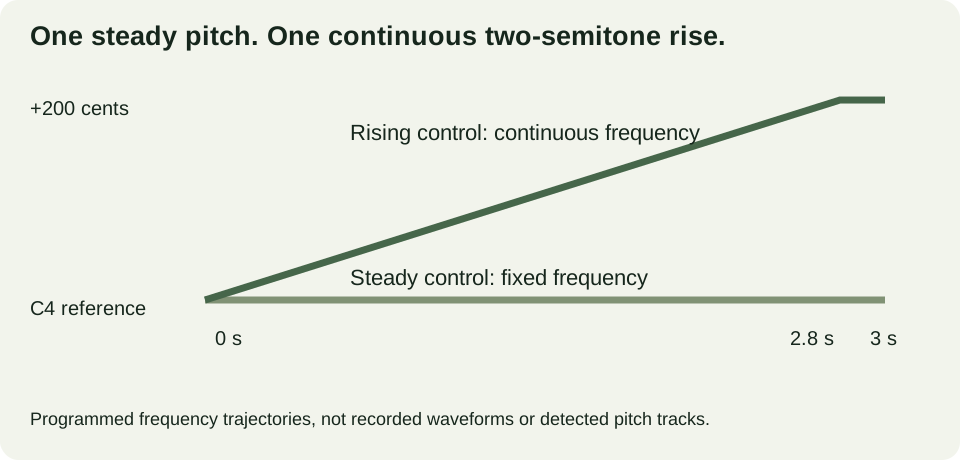
We made two original mono, signed 16-bit PCM WAVs at 22,050 samples per second. Both have 66,150 samples and 132,344 bytes. Duration is 66,150 ÷ 22,050 = 3 seconds. Both use the same amplitude envelope, with a programmed 0.02-second fade-in and a 0.08-second fade-out. There is no accompaniment, voice, vibrato or source MIDI performance in these inputs.
The steady oscillator uses f₀ = 440 × 2^((60 − 69) ÷ 12) ≈ 261.625565 Hz throughout. The rising oscillator uses cents(t) = 200 × min(t ÷ 2.8, 1), then f(t) = f₀ × 2^(cents(t) ÷ 1200). It rises by two semitones over 2.8 seconds and holds the final frequency for the remaining 0.2 seconds. These are generator settings, not estimates from a recording.
We advance a shared oscillator phase by 2π × f(i ÷ 22,050) ÷ 22,050 at each sample, rather than restarting a new tone at each pitch. The saved integer sample is round(sin(phase) × 0.32 × min(t ÷ 0.02, 1) × min((3 − t) ÷ 0.08, 1) × 32,767). This construction makes the rising control a continuous frequency trajectory rather than three separately keyed notes.
Verify the stored cycles before interpreting the output
An independent Ruby reader checked the RIFF headers and the saved signed PCM samples. Within each stated time window it located positive-going zero crossings, using linear interpolation between adjacent integer samples. Window cycle rate equals (crossing count − 1) × 22,050 ÷ (last crossing frame − first crossing frame). The raw record keeps all crossing positions and both window boundaries.
The steady control's rates are approximately 261.625577, 261.625548, 261.625544 and 261.625626 Hz in the four windows below. The rising control's corresponding rates increase from approximately 263.790014 to 293.664657 Hz. This independently checks that the saved rising WAV contains changing cycles, while the control remains near its programmed reference.
| Window (s) | Crossings | Cycle rate (Hz) |
|---|---|---|
| 0.1–0.3 | 52 | 263.790014 |
| 1.3–1.5 | 55 | 277.178377 |
| 2.6–2.8 | 58 | 292.464641 |
| 2.85–2.95 | 29 | 293.664657 |
These are window cycle rates, not instantaneous pitch readings at a midpoint. Frequency is changing within the first three rising windows, so their values summarize several cycles. The last window lies after the programmed rise and is close to the final reference f₀ × 2^(200 ÷ 1200) ≈ 293.664768 Hz. This is a check on these stored signals, not a tuning measurement for a singer.
The rising download contains three integer keys and no bend
We separately selected both saved WAVs in the production converter in Chrome on 13 November 2026, using export BPM 120 with the clear-final-release estimate enabled. Selecting the rising file cleared the steady result before the second conversion. We clicked each native Download .mid link, then independently parsed the newly saved files with Ruby.
The steady result is a 56-byte format-zero file with one C4 event, numeric key 60. The rising result is 74 bytes and contains keys 60, 61 and 62, displayed as C4, C♯4 and D4. Each file has one track, 480 ticks per quarter note and one 500,000-microsecond tempo event. All exported note velocities are 88. Neither file contains a Pitch Bend Change event.
Steady control
One key, one note span.
Rising control
Three keys replace the smooth rise.
| Input | Key | Start tick | End tick | Start (s) | End (s) |
|---|---|---|---|---|---|
| Steady | 60 | 0 | 2809 | 0.000000 | 2.926042 |
| Rising | 60 | 0 | 624 | 0.000000 | 0.650000 |
| Rising | 61 | 624 | 1984 | 0.650000 | 2.066667 |
| Rising | 62 | 1984 | 2809 | 2.066667 | 2.926042 |
Seconds equal tick ÷ 480 × 500,000 ÷ 1,000,000, or tick ÷ 960. The rising transitions are therefore 624 ÷ 960 = 0.65 seconds and 1984 ÷ 960 ≈ 2.066667 seconds. Its neighboring note spans touch at those ticks. These are exported key boundaries, not measured moments when a performer intended to change notes.
Both final notes end at tick 2809, or 2809 ÷ 960 ≈ 2.926042 seconds. Relative to the complete three-second input, the endpoint difference is 2809 ÷ 960 − 66,150 ÷ 22,050 ≈ −0.073958 seconds. Matching endpoints between the two outputs does not establish full duration recovery, and successful downloads do not establish continuous-pitch recovery.
A key sequence is different from a continuous pitch curve
The Mido message reference lists note_on and note_off with an integer note field, and pitchwheel with a separate pitch field. Checking only the displayed note names would miss that distinction. Our full channel-event inspection found note events without Pitch Bend events, rather than a bend hidden by the note-list display.
The current exporter implementation writes integer note values. This source reading is consistent with the saved files; we did not capture intermediate detector frames or isolate every stage of the algorithm. We also did not open a DAW or measure how a particular synthesizer plays the files. These event results do not establish that every possible audio-to-MIDI system handles slides in the same way.
When a slide matters, compare pitch movement as well as note count. In your music editor, review whether you need a continuous-pitch control or deliberate note steps, and audition the chosen instrument. That is an editing recommendation, not a workflow tested here. For selection and download steps, use the audio-to-MIDI tutorial.
A constant fine-tuning offset is a different input from a slide that changes over time. Likewise, separate notes across registers do not test a continuous trajectory. Keep these checks separate when deciding what the draft preserves.
Watch the sliding-pitch check
Compare the continuous rising input with the steady control and the actual exported note steps.
Download the exact inputs and actual MIDI
Use either original WAV in the live converter, then compare its result with the saved export.
Steady control
Original recording and its separately downloaded result.
Steady control WAV Actual steady MIDIRising control
Original recording and its separately downloaded result.
Rising control WAV Actual rising MIDIRead full PCM crossings, MIDI events, hashes and every formula input · Rebuild the original WAV controls.
Two questions before accepting a slide
Do C4, C♯4 and D4 prove that a smooth slide survived?
Editorial question. No. Those three keys describe discrete events. Our rising source changes frequency continuously, while the actual file contains those three notes without Pitch Bend events. The direction and the continuous motion are separate properties.
Can matching the first and last keys validate everything between them?
Editorial question. No. Inspect the intermediate representation and the note boundaries as well. The downloadable record preserves the original frequency formula and every exported channel event, so the endpoint labels do not have to stand in for the missing trajectory.
Scope of this check
This is a narrow comparison of two synthetic mono oscillator files, one amplitude envelope and one Chrome export configuration. It does not measure vocal portamento, acoustic instruments, vibrato, competing converters or an overall transcription accuracy rate. The evidence establishes the actual integer keys, timing and absence of Pitch Bend events in these two saved exports.