Use a clear vocal melody, then check the note events
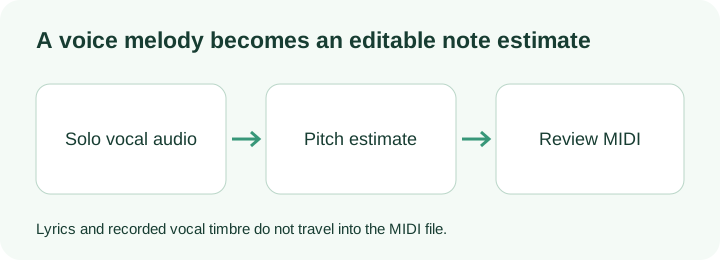
Voice to MIDI estimates note pitches and timing from a recording. Select an isolated sung phrase, use the converter above, then compare the detected notes with what you sang. The file contains note instructions for an instrument; it does not contain your voice, breath, words or room sound.
For vocals to MIDI, accompaniment creates an additional problem: several pitches can sound at once. This page estimates one pitch at a time and does not separate a singer from a finished mix. Use a solo vocal file when you have one, rather than expecting the MIDI to include every voice and instrument.
What to inspect in this particular converter
The note table reports pitch labels, starts and lengths. Check them separately: a matching note name does not prove that an attack or release is correct. The download can pass its structural MIDI check while still needing musical editing. That check verifies the header and track length, not agreement with your singing.
Midilot averages stereo channels into one signal. If a singer occupies one side and another sound occupies the other, the exported file does not preserve them as separate tracks. The MIDI export uses one track, a fixed tempo of 120 BPM and velocity 88. Those defaults are not estimates of the singer's tempo or expression.
The detector merges adjacent instances of the same pitch if their gap is shorter than 0.055 seconds. On a repeated syllable, inspect whether two attacks became one longer event. Slides, vibrato and overlapping sounds may need editing because the output is a discrete note estimate, not the complete continuous vocal contour.
Use a known input to learn the checks
The original eight-tone WAV is not a human voice. It was synthesized with programmed C4, D4, E4, G4, A4, G4, E4 and C4 tones, each lasting 0.42 seconds with 0.16 seconds of silence afterward. Its complete duration is 4.64 seconds. It gives you known boundaries before you try a vocal take whose exact ground truth is unavailable.
In the recorded Chrome run on 14 October 2026, the displayed pitch labels followed that sequence. The timing did not consistently follow the input: D4 was programmed to begin at 0.58 seconds, but the note list began it at 0.42 seconds. The displayed difference is 0.42 − 0.58 = −0.16 seconds. This is a reason to inspect timing even after a pitch label looks plausible.
The input parameters, hashes and that run's original rows are available on the WAV reference page. The test demonstrates this detector's behavior on synthesized tones only. It cannot supply a correctness rate for a real singer, whisper, choir or voice memo. For your own recording, compare each phrase against the returned note list before treating it as a playable part.
Try a short clear phrase first. If it has repeated syllables, count the attacks you hear, then count their returned events. If the singer slides between notes, compare the sustained pitch with the surrounding short events. Correct the concrete difference you find instead of assuming the software heard the same musical boundaries you did.
Voice to MIDI free: what is available here
This browser workflow has no account or conversion charge. The same free voice to MIDI route accepts the supported audio formats shown in the picker, when your browser can decode them. The local five-minute limit and single-melody behavior still apply.
Questions about a vocal take
Does it convert spoken words into MIDI lyrics?
No. It estimates pitched events and does not transcribe words or produce a lyric track. Ordinary speech is not necessarily a sequence of stable musical notes.
Why does my downloaded MIDI sound different?
Your music software supplies its instrument sound. The MIDI does not preserve the recording's voice or effects. Choose an instrument and review the note timing before arranging the part.
Can I turn the vocal result into a score?
After checking the notes, open the MIDI in the staff viewer. Its notation is a draft of the estimated events, not proof that the singing was transcribed correctly.
A check of the actual voice-page pipeline
On 14 October 2026, choosing the original eight-tone WAV on this page produced eight displayed events and enabled the MIDI download. The D4 row began at 0.42 seconds and lasted 0.58 seconds, while the programmed tone begins at 0.58 seconds and lasts 0.42 seconds. This repeated the detector timing discrepancy on the voice page itself. It verifies a working input-to-output route, not human-vocal accuracy.