AUDIO TO MIDI / PERIODIC PITCH MOTION
Audio to MIDI with vibrato
A sustained note can move in pitch without becoming a new key.
Measured answer. Our steady and vibrato inputs returned byte-identical MIDI files: one C4, with no Pitch Bend events. The periodic source motion is not distinguished in those saved files. This is one synthetic three-second pair, not a singer or instrument accuracy test. Hear the original inputs below and compare their actual downloads.
One reference pitch, with and without periodic motion
We made two original mono, signed 16-bit PCM WAVs. Each contains 66,150 samples at 22,050 samples per second, so duration = 66,150 ÷ 22,050 = 3 seconds. Each complete file has 132,344 bytes. Both use a 0.25 amplitude coefficient, a 0.02-second attack and a 0.08-second release before integer sample rounding. Neither is a recorded voice or acoustic instrument.
The reference frequency is f₀ = 440 × 2^((60 − 69) ÷ 12) ≈ 261.625565 Hz. The steady version keeps that frequency. In the other version, cents[n] = 35 × sin(2π × 5 × n ÷ 22,050), then f[n] = f₀ × 2^(cents[n] ÷ 1200). These are programmed source values: a 35-cent excursion on either side of the center, repeating five times per second. They are not a recommended performance setting.
The oscillator starts with phase zero. At each sample we save the rounded sine value at the current phase, with the shared envelope, then advance phase by 2π × f[n] ÷ 22,050. We do not restart separate tones at the top and bottom of the motion. The public generator rebuilds both complete WAVs byte for byte. Their different SHA256 hashes are retained beside the construction inputs.
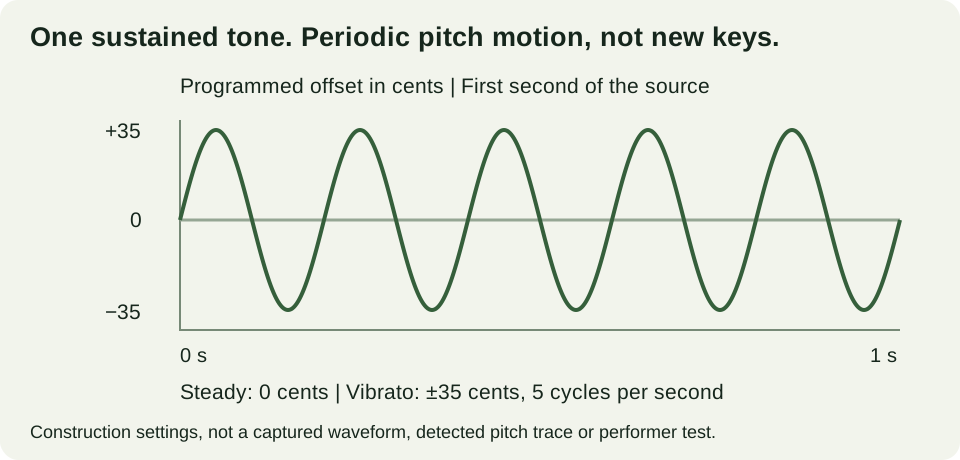
Hear the source before judging its MIDI
These players use the original saved WAVs, not a synthesizer rendering of the returned MIDI. They start only when you press play. Keep the source motion separate from any vibrato an instrument might add during MIDI playback.
Steady reference
Programmed pitch offset stays at zero cents.
Actual MIDI: one C456 bytes · no Pitch Bend events
Periodic vibrato
Programmed pitch offset moves between −35 and +35 cents at 5 cycles per second.
Actual MIDI: one C456 bytes · no Pitch Bend events
Check that the stored vibrato really changes the cycles
An independent Ruby reader inspected the saved PCM, not the generator's frequency array. In the window from 0.2 to 2.8 seconds, it found 680 positive-going crossings in each file. For adjacent saved samples x ≤ 0 and y > 0, the interpolated crossing position is i + abs(x) ÷ (y − x). Each period-frequency estimate is 22,050 ÷ (next crossing position − current crossing position).
The steady file's estimates range from 261.622133 to 261.628313 Hz. The modulated file's estimates range from 256.390363 to 266.968399 Hz. Every crossing position and the pairs producing each extreme are in the raw record. We rechecked the saved samples on 18 November; the original construction and first measurements retain their earlier dates.
For example, the modulated minimum uses crossing positions 29,733.177257525083 and 29,819.178929765887 samples: 22,050 ÷ (29,819.178929765887 − 29,733.177257525083) ≈ 256.390363 Hz. This is an estimate over a complete stored cycle. It is not the instantaneous frequency at either endpoint, a MIDI pitch value or a microphone measurement.
Both actual files contain the same single note
We first converted the original pair in production Chrome on 17 November, then repeated both selections, conversions and native downloads on 18 November. The export BPM was 120, with the clear-final-release estimate enabled. Choosing the second file cleared the first download before conversion. Newly saved files were independently parsed and matched the earlier complete MIDI bytes.
Both outputs are 56-byte format-zero Standard MIDI Files with one track and 480 ticks per quarter note. Each has key 60, displayed as C4, velocity 88, start tick zero and end tick 2809. Each contains a tempo event of 500,000 microseconds per quarter note. Complete channel-event inspection found a Note On and a Note Off, with no Pitch Bend or controller event. The two full file hashes are identical, not just their note names.
| Source | Key | Velocity | Start tick | End tick | Pitch Bend events |
|---|---|---|---|---|---|
| Steady | 60 / C4 | 88 | 0 | 2809 | 0 |
| Vibrato | 60 / C4 | 88 | 0 | 2809 | 0 |
At this exported tempo, seconds = tick ÷ 480 × 500,000 ÷ 1,000,000 = tick ÷ 960. The note ends at 2809 ÷ 960 ≈ 2.926042 seconds. Its difference from the complete source length is (2809 − 3 × 960) ÷ 960 = −71 ÷ 960 ≈ −0.073958 seconds. An identical ending in two exports does not establish recovery of the complete three-second source or its final fade.
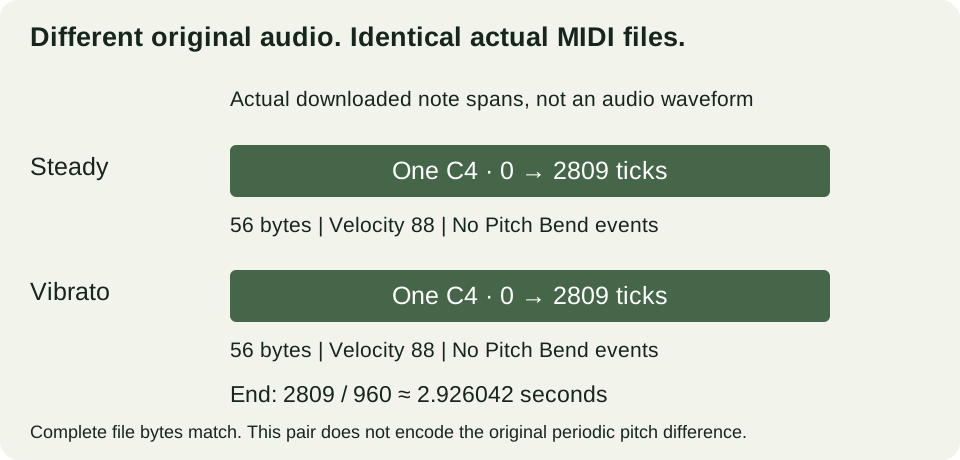
A sustained key is different from its pitch movement
The Mido message reference lists the note field on note messages separately from the pitch field on pitchwheel messages. A single C4 can therefore describe a held key without encoding the source's changing pitch. In this pair we checked the full channel events rather than relying only on the converter's note table.
The current exporter implementation writes integer note values. This source reading is consistent with the actual files; it does not identify which internal analysis step led to the result. We did not capture intermediate detector frames, test another converter, sweep modulation settings or measure a performer. A playback instrument could supply its own vibrato even when the saved file has no pitch motion events. We did not test that instrument behavior.
Compare with the original when expressive movement matters. A constant tuning offset and a one-way slide are different source constructions. This periodic case is not another tool page for either of them. For file selection and saving steps, use the audio-to-MIDI tutorial.
Watch the sustained-note check
Compare the programmed pitch motion with the identical actual MIDI files. The original audio and full evidence remain available below.
Download the exact pair and actual MIDI
Steady reference
Original source and its actual native export.
Steady reference WAV Actual steady MIDIPeriodic vibrato
Original source and its actual native export.
Periodic vibrato WAV Actual vibrato MIDIRead the full crossing positions, hashes, events and calculation inputs · Rebuild both original WAVs.
Questions about vibrato and the saved note
Does one C4 note mean the source vibrato was preserved?
Editorial question. It did not establish that here. The steady and modulated sources produced the same complete MIDI bytes, and neither export contains Pitch Bend events. Their different recorded pitch motion is not distinguished by these files.
Would hearing vibrato from a synthesizer prove the source movement survived?
Editorial question. No. The instrument can affect the sound independently of the file's note events. Inspect the saved events and compare with the original source. We have not measured a particular synthesizer or its settings in this check.