AUDIO TO MIDI / FOLLOWING THE REGISTER
Audio to MIDI for a melody with octave leaps
Compare complete MIDI keys, including the octave, before accepting a large register jump. A pitch-class label alone leaves part of the result unchecked.
Measured answer. Both actual downloads retained all six full MIDI keys in their own reference order, including the wide control’s C3/C5 jumps. Note starts still differ from the programmed times. These are two synthetic tone sequences, not a guarantee for real performances.
Two different pitch designs, each with its own reference
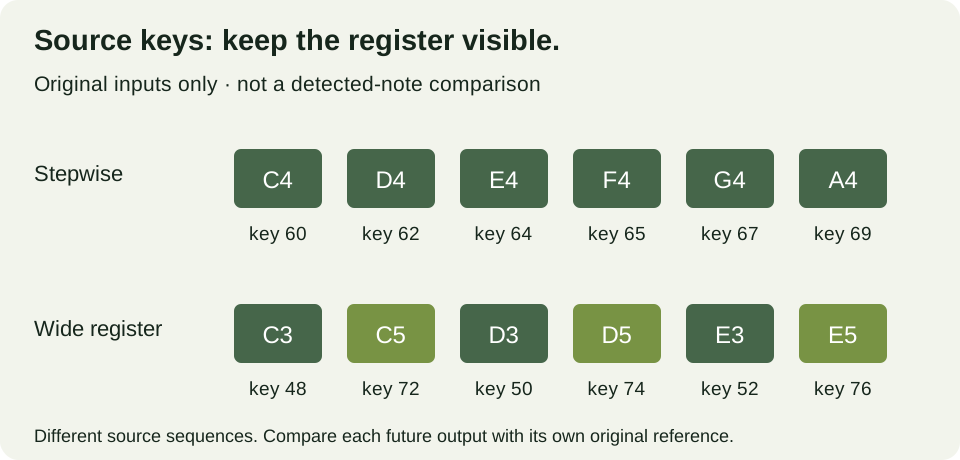
The stepwise control contains MIDI keys 60, 62, 64, 65, 67 and 69. With Midilot's naming convention, these are C4, D4, E4, F4, G4 and A4. Adjacent key differences are +2, +2, +1, +2 and +2 semitones. Its source register spans max(key) − min(key) = 69 − 60 = 9 semitones.
The wide-register control contains keys 48, 72, 50, 74, 52 and 76: C3, C5, D3, D5, E3 and E5. Its adjacent differences are +24, −22, +24, −22 and +24 semitones. The rising jumps each cover 24 ÷ 12 = two octaves; the descending moves are not exact two-octave jumps. Its full source span is 76 − 48 = 28 semitones.
Stepwise control
- 1 · key 60C4
- 2 · key 62D4
- 3 · key 64E4
- 4 · key 65F4
- 5 · key 67G4
- 6 · key 69A4
Source span = 69 − 60 = 9 semitones.
Wide-register control
- 1 · key 48C3
- 2 · key 72C5
- 3 · key 50D3
- 4 · key 74D5
- 5 · key 52E3
- 6 · key 76E5
Source span = 76 − 48 = 28 semitones.
These are different melodies, not one melody shifted by a constant transposition. The wide-register design also has different pitch content. Any future output must be checked against its own source sequence. Comparing the two alone would not isolate jump size as the only cause of a conversion difference.
Keep the timing, velocity and renderer setting fixed
Both original files are 92-byte, format-0 Standard MIDI Files, with one track and 480 ticks per quarter note. Each has a 500,000-microsecond quarter note, equivalent to 120 BPM. Starts are ticks 0, 480, 960, 1440, 1920 and 2400; each keyed note lasts 336 ticks at velocity 88 on channel zero. An independent Ruby parser checked the saved files against these values.
Seconds equal tick ÷ 480 × 500,000 ÷ 1,000,000, or tick ÷ 960. The starts are therefore 0, 0.5, 1, 1.5, 2 and 2.5 seconds, with a keyed duration of 336 ÷ 960 = 0.35 seconds. Those are programmed instructions, not measurements of a performer's attack or the detector's returned boundaries.
Build the actual audio inputs
We executed the exact current production MIDI and audio helper locally in Node, using Soft sine for both inputs. Its frequency expression is 440 × 2^((MIDI key − 69) ÷ 12). Here 440 Hz is the renderer's chosen reference. It does not establish the tuning of a real singer or instrument.
Each generated WAV has 73,868 mono frames at 22,050 samples per second, stored as 16-bit PCM in a 147,780-byte file. Its duration is 73,868 ÷ 22,050 ≈ 3.350023 seconds. The renderer allocates a tail after the final keyed note. The two WAVs have different samples and hashes; equal byte lengths do not make them the same recording.
The reproduction script reads the original MIDI inputs and writes both WAVs with that helper. We then selected the actual WAV files separately in production Chrome. Local rendering and browser transcription are different stages, and both are recorded in the raw test file.
Verify the register in the stored source audio
We independently read each WAV's signed PCM16 samples. For every source note, the measurement window starts 0.06 seconds after its programmed start and ends at 0.29 seconds, inside the steady part of this generated tone. Within that window, we interpolate each nonpositive-to-positive zero crossing between neighboring samples.
Measured frequency equals (crossing count − 1) × 22,050 ÷ (last interpolated crossing frame − first interpolated crossing frame). Each crossing position is i + (−sample[i]) ÷ (sample[i+1] − sample[i]). The raw reference keeps the frame boundaries, crossing counts and every interpolated position, so the displayed values can be reconstructed independently.
| Control | Position | Source key | Programmed Hz | Measured PCM Hz |
|---|---|---|---|---|
| Stepwise | 1 | 60 · C4 | 261.626 | 261.626 |
| Stepwise | 2 | 62 · D4 | 293.665 | 293.665 |
| Stepwise | 3 | 64 · E4 | 329.628 | 329.628 |
| Stepwise | 4 | 65 · F4 | 349.228 | 349.228 |
| Stepwise | 5 | 67 · G4 | 391.995 | 391.995 |
| Stepwise | 6 | 69 · A4 | 440.000 | 440.000 |
| Wide | 1 | 48 · C3 | 130.813 | 130.813 |
| Wide | 2 | 72 · C5 | 523.251 | 523.251 |
| Wide | 3 | 50 · D3 | 146.832 | 146.832 |
| Wide | 4 | 74 · D5 | 587.330 | 587.330 |
| Wide | 5 | 52 · E3 | 164.814 | 164.814 |
| Wide | 6 | 76 · E5 | 659.255 | 659.255 |
For the wide control's first pair, the programmed key difference is 72 − 48 = 24 semitones. The renderer's frequency ratio is 2^(24 ÷ 12) = 4. Independently measured source frequencies are approximately 130.813 and 523.251 Hz. This verifies the constructed input register; it does not demonstrate that a detector recovered either key.
Both actual exports retained their full source-key sequence
On 11 November 2026, we selected each original WAV separately in the live WAV-to-MIDI converter in Chrome. Export BPM was 120 and the final-release estimate was enabled. Selecting the wide-register file cleared the earlier draft. We clicked each new native download link, saved the files and independently parsed them with Ruby.
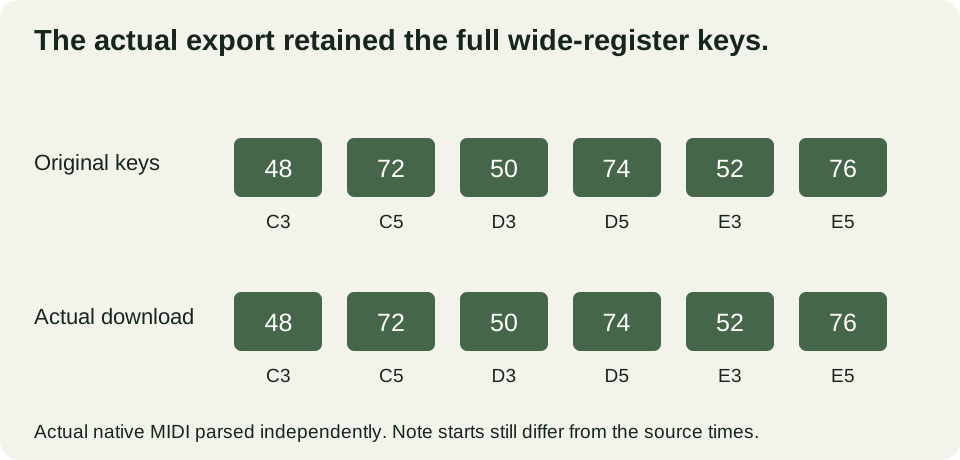
The stepwise export contains 60, 62, 64, 65, 67 and 69. The wide-register export contains 48, 72, 50, 74, 52 and 76. Each sequence exactly matches its own original six full keys, including the octave distinctions. Under that exact ordered-sequence check, neither run has a missing or extra note. This describes these two files; it is not a transcription accuracy percentage for other recordings.
Each actual file is a 101-byte, format-0 Standard MIDI File with one track and 480 ticks per quarter note. They have different pitch data and hashes; equal byte length does not mean identical files. The raw record preserves all note, channel and meta-events, together with the original instructions and input-tone measurements.
| Position | Source key | Actual key | Source start (s) | Actual start (s) | Actual end (s) |
|---|---|---|---|---|---|
| 1 | 48 | 48 | 0.000000 | 0.000000 | 0.441667 |
| 2 | 72 | 72 | 0.500000 | 0.441667 | 0.929167 |
| 3 | 50 | 50 | 1.000000 | 0.929167 | 1.439583 |
| 4 | 74 | 74 | 1.500000 | 1.439583 | 1.927083 |
| 5 | 52 | 52 | 2.000000 | 1.927083 | 2.438542 |
| 6 | 76 | 76 | 2.500000 | 2.438542 | 2.853125 |
The two designs also differ in pitch content, so their matching outcomes do not isolate leap size as a causal variable. The useful observation is narrower: each of these actual exports preserves its own programmed register. We did not test an acoustic instrument, voice or another converter.
Correct octaves still leave note timing to review
Both exports start their notes at ticks 0, 424, 892, 1382, 1850 and 2341, instead of the original 0, 480, 960, 1440, 1920 and 2400. Their onset differences in ticks are 0, −56, −68, −58, −70 and −59. We first verified equal six-note counts and exact full-key sequence equality in each run, then paired chronological notes by index. No unmatched notes were discarded to make this comparison.
Mean absolute onset difference equals sum(|actual start − source start|) ÷ 6 ÷ 960 seconds. Here it is (0 + 56 + 68 + 58 + 70 + 59) ÷ 6 ÷ 960 = 311 ÷ 5760 ≈ 0.053993 seconds for either run. This is a difference from programmed MIDI starts, not a latency correction or a general accuracy score.
The first actual end is tick 401 in the stepwise file and tick 424 in the wide file. The other ends are 892, 1382, 1850, 2341 and 2739. The original key ends are 336, 816, 1296, 1776, 2256 and 2736. For the last note, the difference is (2739 − 2736) ÷ 960 = 0.003125 seconds. The source renderer also adds a release tail after a key is released, so keyed ends and audible tone endings are different references. We did not measure a performer's attack or release.
Why a complete MIDI key matters
The MIDI Association's message summary identifies a key number as a Note On field. Midilot's name helper computes pitch class from key modulo 12, and the octave label from floor(key ÷ 12) − 1. The naming convention here is the one used by Midilot; labels in another editor can differ.
Keep the numeric key beside its displayed label when reviewing the draft. In these two runs the full keys match the references; a bare pitch-class comparison would have checked less information. The actual onset and ending differences remain separate observations.
Download both controls and their actual MIDI exports
Each group keeps the original instructions, locally rendered WAV and actual production-browser output together.
Stepwise source
Original input and the separately saved production transcription.
Original stepwise MIDI Rendered stepwise WAV Actual stepwise MIDIWide-register source
Original input and the separately saved production transcription.
Original octave-leaps MIDI Rendered octave-leaps WAV Actual octave-leaps MIDIAll original events, actual MIDI events, PCM measurements, hashes and formulas
A question before accepting a large jump
Does a matching C label prove that the octave is correct?
Editorial question. No. Source keys 48 and 72 both give 0 under key modulo 12, corresponding to C. Midilot labels them C3 and C5 because floor(48 ÷ 12) − 1 = 3 and floor(72 ÷ 12) − 1 = 5. They are 24 semitones apart. Our actual wide-register export preserves both full keys, while its timing still differs from the original instructions. A matching C label alone would not establish either result.
What these two checks establish
These are two isolated synthetic sequences with equal source velocities and one renderer setting. They have different pitch content and are each checked against their own reference. We tested one Chrome export configuration, not real vocal or acoustic-instrument recordings. The actual files establish the retained full keys and the timing differences for these inputs; they do not establish a general accuracy rate or the result for other recordings.
For the general workflow, see how to convert audio to MIDI. Moving the whole melody by a constant transposition and checking a fine tuning offset are separate tasks.