AUDIO TO MIDI / KEEPING THE BAR LINES
Audio to MIDI for a melody in three-quarter time
Check the time-signature event separately from the notes and BPM before arranging a three-beat phrase.
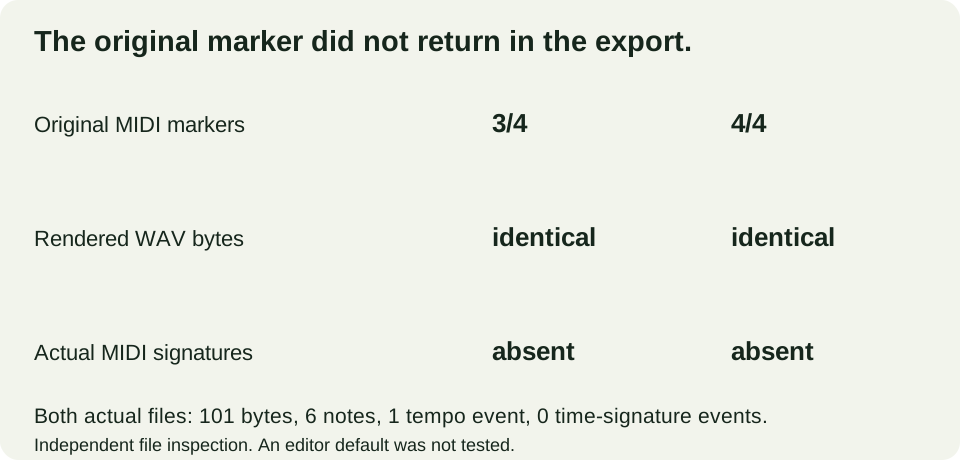
Measured answer. Neither actual MIDI export kept a time-signature event. Our 3/4 and 4/4 controls rendered to identical WAV audio, then produced identical six-note MIDI files. This is a metadata control, not a test of recognizing an accented waltz.
Change the marker, keep every note event
We prepared two original Standard MIDI Files. Each contains C4, E4, G4, C4, E4 and G4, with note numbers 60, 64, 67, 60, 64 and 67. Starts are ticks 0, 480, 960, 1440, 1920 and 2400. Each note lasts 336 ticks, has velocity 88 and uses channel zero. Both files use one track, 480 ticks per quarter note and a 500,000-microsecond quarter note, equivalent to 120 BPM.
Independent byte inspection found exactly one difference between the two 100-byte inputs: at zero-based byte offset 33, the first stores 3 and the other stores 4. It is the numerator inside the time-signature meta-event. Their full payloads are [3, 2, 24, 8] and [4, 2, 24, 8]. The stored denominator byte is an exponent: 2^2 = 4. All note and tempo events match. The raw record preserves every parsed event and both file hashes.
Here, seconds equal tick ÷ 480 × 500,000 ÷ 1,000,000, or tick ÷ 960. The six starts are therefore 0, 0.5, 1, 1.5, 2 and 2.5 seconds, with a keyed duration of 336 ÷ 960 = 0.35 seconds. Changing this marker does not change those programmed seconds. We did not add a stronger downbeat, a click or a different playing pattern to either input.
The same six starts can have different bar boundaries
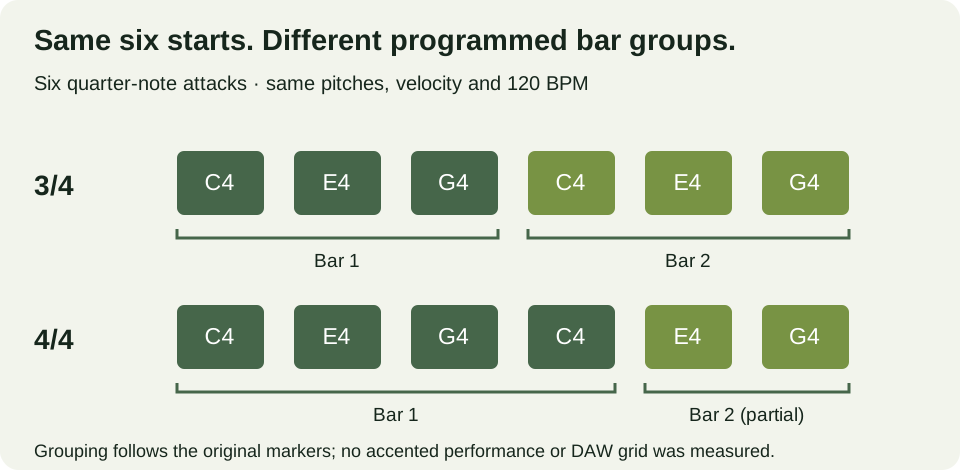
Taking tick zero as the start of the first bar, the 3/4 marker groups our quarter-note starts as three plus three. The 4/4 marker groups them as four plus two. The second 4/4 group is partial; the files do not contain padding to complete that bar. These diagrams organize the programmed attacks, not a measured accent pattern or a displayed DAW grid.
Original 3/4 marker
3 quarter-note positions per nominal bar.
Original 4/4 marker
4 quarter-note positions per nominal bar.
Quarter notes per nominal bar equal numerator × 4 ÷ denominator. With our tempo, nominal bar duration equals that result × 500,000 ÷ 1,000,000 seconds. Thus 3 × 4 ÷ 4 × 0.5 = 1.5 seconds for 3/4, while 4 × 4 ÷ 4 × 0.5 = 2 seconds for 4/4. These calculated bar spans are separate from the final note's release and the rendered audio tail.
The audio no longer distinguishes the two markers
We ran the exact production MIDI and audio helper locally in Node with its Soft sine setting. Each rendered WAV has 73,868 mono frames at 22,050 samples per second, stored as 16-bit PCM in a 147,780-byte file. Duration is 73,868 ÷ 22,050 ≈ 3.350023 seconds. The allocated buffer includes the renderer's tail; it is not a count of complete musical bars.
The complete WAV bytes match, not merely their lengths. This establishes that the differing original markers created no audio difference under this specific renderer and these settings. Inference: a converter receiving these exact bytes has no input-byte distinction from which to recover which of our two markers was supplied. It might choose or estimate a meter, but it cannot establish the original marker from a difference that is absent here.
The helper's parser retains tempo and note data for its renderer but does not retain the time-signature meta-event. This is implementation analysis, separate from the full-byte comparison. We have not shown that real 3/4 and 4/4 performances sound identical, or that a meter model cannot use accents and phrasing in actual recordings.
Run both audio files on the live converter
On 10 November 2026, we selected each WAV separately in the production WAV-to-MIDI converter in Chrome, keeping export BPM at 120 and the final-release estimate enabled. Selecting the second input cleared the first draft. Each conversion produced a new download link.
We clicked both native MIDI links and independently parsed the files saved to disk with Ruby. We checked the complete bytes, note times and meta-events, including event type 0x58 for a time signature. The inputs were rendered locally from current production source; this was not a browser-renderer or competitor-conversion test.
Six pitches returned, but no time-signature event did
Both actual downloads are identical 101-byte, format-0 Standard MIDI Files with one track and 480 ticks per quarter note. Each contains six notes in the original pitch order and a single 500,000-microsecond tempo event. Neither contains a time-signature event. The 120-BPM value was the export setting; it is not evidence that a three-beat grouping was detected.
The independent parser found track-name, tempo and end-of-track meta-events, along with the note messages. It did not find a 3/4 or a 4/4 time-signature payload in either export. We therefore record an absent marker, rather than calling the output an explicit 4/4 transcription. We did not open a DAW or measure a receiving application's default grid.
Pitch order alone would miss this difference in information. All six note names can be correct while the original bar-grouping instruction is absent. In this controlled case, the identical audio also means that the missing distinction arose before transcription. We do not attribute the result to a failed recognition of an accented three-quarter recording.
Check timing before adding bar lines
The outputs share start ticks 0, 424, 892, 1360, 1850 and 2341, with end ticks 401, 892, 1360, 1850, 2318 and 2749. Those are not all the original note boundaries. The table uses tick ÷ 960 for seconds, rounded to six decimals.
| Note | Input start (ticks) | Output start (ticks) | Output start (s) | Output end (s) |
|---|---|---|---|---|
| 1 · C4 | 0 | 0 | 0.000000 | 0.417708 |
| 2 · E4 | 480 | 424 | 0.441667 | 0.929167 |
| 3 · G4 | 960 | 892 | 0.929167 | 1.416667 |
| 4 · C4 | 1440 | 1360 | 1.416667 | 1.927083 |
| 5 · E4 | 1920 | 1850 | 1.927083 | 2.414583 |
| 6 · G4 | 2400 | 2341 | 2.438542 | 2.863542 |
The fourth note begins at 1360 ÷ 960 ≈ 1.416667 seconds, compared with the programmed 1440 ÷ 960 = 1.5 seconds. Its difference is (1360 − 1440) ÷ 960 ≈ −0.083333 seconds. It is also the programmed first attack of our second 3/4 group. Recognizing its pitch did not establish a correct downbeat alignment. This is a file-relative timing comparison, not a universal correction or a measurement of a musician's attack.
Keep meter, tempo and note placement as separate checks
The Mido project's time-signature documentation lists numerator and denominator as fields of a separate meta-message. Its primary decoding implementation also shows how the stored denominator becomes a power of two. Those definitions explain our inspection, rather than supplying an accuracy claim.
Preserve the first draft and recording
Keep the original MIDI if you already have it and need its bar-grouping instructions. A rendered recording is a different kind of input.
Review note boundaries before aligning a grid
Compare attacks and releases with the recording. Matching the pitch sequence does not establish that the first beat of a bar lands at the intended point.
Set or verify the time signature in your editor
Use the intended arrangement or score as your reference. Treat a default grid as a setting to inspect, rather than proof that the converter recovered the source meter. A tempo change and a time-signature change are separate decisions.
Watch the time-signature check
See the metadata-only time-signature controls and their actual exports. This is not an accented waltz recognition test.
Download all six test files
Each group contains the original marked MIDI, its rendered WAV and the MIDI actually saved from the corresponding production conversion.
3/4 control
Keep its instructions, rendered audio and actual export together.
Original 3/4 MIDI Rendered 3/4 WAV Actual 3/4-input result4/4 control
Keep its instructions, rendered audio and actual export together.
Original 4/4 MIDI Rendered 4/4 WAV Actual 4/4-input resultAll note and meta-events, comparisons, hashes and formulas · Rebuild both exact WAVs
A question before arranging a three-beat phrase
If the export has 120 BPM and six right notes, is its 3/4 meter confirmed?
Editorial question. No. Our actual exports have that tempo and the six pitch names, but no time-signature event. The 120 BPM came from the export setting. The original 3/4 and 4/4 markers also rendered to identical audio, so this pair cannot establish meter recognition from a real performance. Inspect the marker and intended bar alignment separately.
What this control leaves untested
These are six equal-velocity synthesized tones with two metadata labels. They contain no deliberately accented downbeat, drums, expressive phrasing or recording of a waltz. We tested one renderer and one Chrome export configuration. The files establish which instructions survived this path; they do not measure general meter recognition, notation quality or any receiving software's default behavior.
For the basic workflow, see how to convert audio to MIDI. The tempo-matched loop check compares beat and second units; tempo changes inside a phrase and swung note spacing are separate cases.