AUDIO TO MIDI / VOLUME WITHIN A HELD NOTE
Audio to MIDI with tremolo
Can one held MIDI key preserve a pulsing volume?
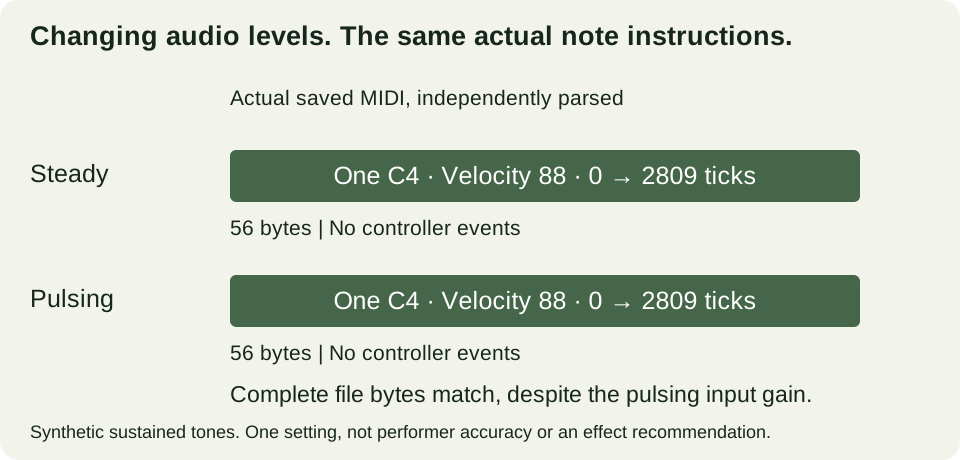
Measured answer. Our pulsing-volume source returned the same complete MIDI bytes as the steady control: one C4 at velocity 88, with no controller events. The source's changing level is not distinguished in those files. This is one synthetic three-second amplitude-modulation pair, not a musician's tremolo accuracy test.
A changing level without another key attack
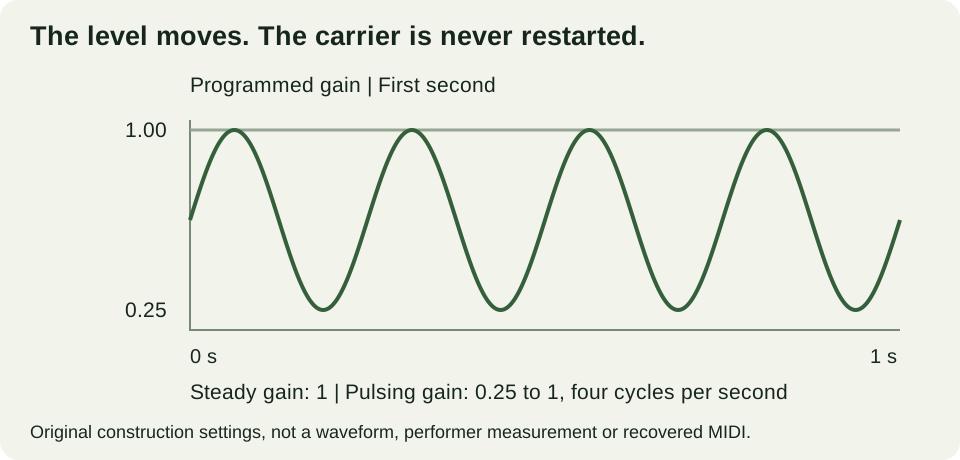
Our source carrier is one uninterrupted sine tone at 440 × 2^((60 − 69) ÷ 12) ≈ 261.625565 Hz. It has a 0.25 amplitude coefficient and a shared outer envelope: a 0.02-second attack and a 0.08-second release. The steady version keeps that envelope. The other multiplies the same unrounded carrier by g[i] = 0.625 + 0.375 × sin(2π × 4 × i ÷ 22,050) before signed PCM16 rounding.
Programmed gain ranges from 0.25 to 1 and repeats four times per second. It never deliberately gates the carrier to zero or restarts its phase. This is amplitude modulation within a held tone. We do not program a sequence of new key attacks, and the carrier frequency does not oscillate as it did in the separate vibrato check.
Both saved WAVs are mono, 16-bit PCM at 22,050 samples per second. Each has 66,150 samples and 132,344 bytes, including its WAV header. Duration = 66,150 ÷ 22,050 = 3 seconds. Both measured absolute peaks are 8,192 PCM units. Matching peaks alone therefore cannot identify the time-varying level. The files have different hashes, and the public generator reconstructs both complete files byte for byte.
Inspect the change in the saved PCM
Near a gain crest
Pulsing RMS ÷ steady RMS
≈ 0.994×Frames 1103 to 1654, excluding the final frame; 551 saved samples from each file.
Near a gain trough
Pulsing RMS ÷ steady RMS
≈ 0.256×Frames 3859 to 4410, excluding the final frame; 551 saved samples from each file.
An independent reader decoded both stored files and checked all 66,150 paired samples. If s is the rounded steady sample and m is the rounded modulated sample, abs(m − s × g) must be no greater than 0.5 + 0.5 × g. That bound follows from independently rounding the same underlying carrier twice; it is not a conversion error score. Every saved pair satisfies it. The raw record retains the maximum-error frame, both integer samples, gain and bound.
We also measured two finite windows after the shared attack and before the final release. Each contains 551 samples from the same frame positions in each source. RMS = sqrt(sum(sample²) ÷ 551). The paired level ratio is pulsing RMS ÷ steady RMS, equivalently sqrt(pulsing square sum ÷ steady square sum). Comparing paired windows keeps the carrier segment and outer envelope aligned.
For frames 1103 through 1653, the steady square sum is 18,454,858,844 and the pulsing sum is 18,230,740,709. The paired ratio is sqrt(18,230,740,709 ÷ 18,454,858,844) ≈ 0.993909. For frames 3859 through 4409, the corresponding sums are 18,572,542,355 and 1,219,683,331, giving sqrt(1,219,683,331 ÷ 18,572,542,355) ≈ 0.256264. These are finite-window saved-audio measurements, not instantaneous gain values or MIDI velocities.
Hear the volume motion in the original pair
These players use the actual WAV inputs. A synthesizer rendering the returned note would be a different signal and could add its own effects. Neither player starts automatically.
Steady source
The uninterrupted carrier with its shared outer fade.
Pulsing source
The same carrier multiplied by positive, periodic gain.
The actual export contains one attack, not a level curve
On 19 November 2026 we separately selected both original WAVs in the production converter in Chrome. Export BPM was 120 and the clear-final-release estimate was enabled. Selecting the second input cleared the old download before its new conversion. We clicked each native Download .mid link, checked the newly saved files and independently parsed their complete events.
Each output is a 56-byte format-zero Standard MIDI File with one track, 480 ticks per quarter note and one tempo event of 500,000 microseconds per quarter note. Each has one key 60, displayed as C4, at velocity 88. It starts at tick zero and ends at tick 2809. Both complete SHA256 hashes match; this is stronger than seeing equal note names in the preview.
| Source | Key | Velocity | Start tick | End tick | Controller events |
|---|---|---|---|---|---|
| Steady | 60 / C4 | 88 | 0 | 2809 | 0 |
| Pulsing | 60 / C4 | 88 | 0 | 2809 | 0 |
Seconds = tick ÷ 480 × 500,000 ÷ 1,000,000 = tick ÷ 960. Thus each note ends at 2809 ÷ 960 ≈ 2.926042 seconds. Compared with the complete three-second source, the difference is (2809 − 2880) ÷ 960 = −71 ÷ 960 ≈ −0.073958 seconds. The equal final boundary does not validate the full source fade or its changing volume.
Separate an attack value from a recorded envelope
The Mido message reference describes a velocity field on note messages and separate control_change messages. Our inspection found only the note channel events in this pair. We did not infer expression recovery from a key label or treat a single velocity value as a measured copy of the audio envelope.
The current exporter assigns its note velocity rather than tracing the source's continuous amplitude. That implementation reading is consistent with the actual downloads. We did not capture intermediate detector frames or identify every stage behind the result. We also did not compare another converter, sweep modulation speeds, test a recorded instrument or measure how a particular synthesizer responds.
This check concerns motion within one held tone. Different velocities on separate keyed notes, periodic pitch motion and repeated attacks describe other inputs. For the selection and download procedure, use the conversion tutorial. Audition against the original before deciding how to edit expression in your music software.
Watch the pulsing-volume check
See the positive gain construction and the same actual note instructions. The original audio and complete measurement inputs are available below.
Download the pair and its actual native exports
Steady source
Keep the recorded signal beside its actual note export.
Steady source WAV Actual steady MIDIPulsing source
Keep the recorded signal beside its actual note export.
Pulsing source WAV Actual pulsing MIDIRead the square sums, rounding check, hashes and complete MIDI events · Rebuild the original audio pair.
Questions about pulsing sound and saved notes
Should four volume pulses per second become four new MIDI attacks?
Editorial question. Our carrier has no new programmed key attacks. The actual file returned one C4 event, so we do not invent a multi-note target or call the pulse count a missing-note accuracy rate. It is the within-note level motion that the two identical files fail to distinguish.
Can equal peak levels prove that both sources have the same dynamics?
Editorial question. No. Both saved sources peak at 8,192 PCM units, but their paired window ratios differ. A peak is one extreme, while these finite RMS windows inspect different parts of the level pattern. Neither audio measurement is itself a returned MIDI expression event.