AUDIO TO MIDI / ONE DELAYED COPY
Audio to MIDI with an echo
Will an audible repeat become another note?
Measured answer. Adding one delayed copy did not double our melody's MIDI note count: both real exports contain six notes. The last note ends 0.3 seconds later in the echo result, while other boundaries also change. This is one synthetic delayed-copy check, with overlapping pitches, not a room-reverb test or a recommendation to add an effect.
One melody, plus one exact delayed copy
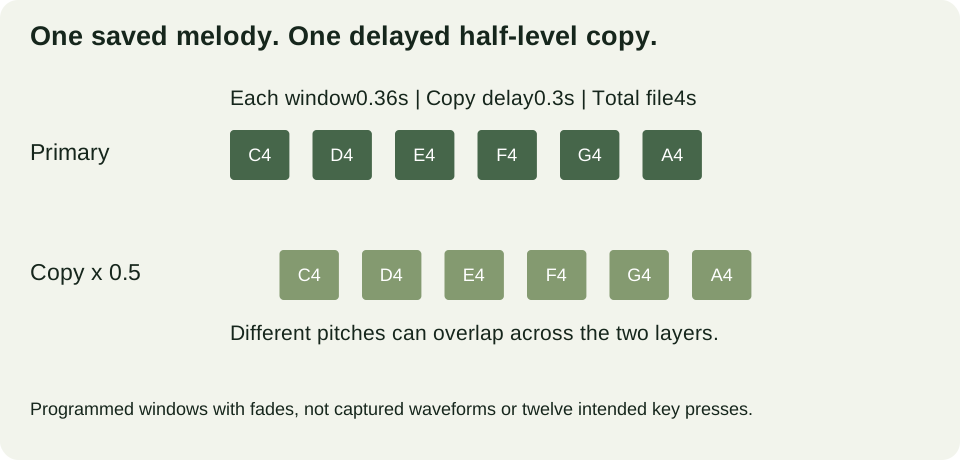
Our original primary melody uses keys 60, 62, 64, 65, 67 and 69, labeled C4, D4, E4, F4, G4 and A4 by this tool. Programmed starts are 0, 0.5, 1, 1.5, 2 and 2.5 seconds. Each sine tone has a 0.36-second window containing a 0.01-second attack and a 0.06-second release. Its amplitude coefficient is 0.25 before signed PCM16 rounding. These are constructed tones, not a recorded musician.
We extend the exact saved clean melody with zero samples to make a four-second control. The other file keeps those samples and adds one half-level copy delayed by 6,615 frames. At 22,050 frames per second, delay = 6,615 ÷ 22,050 = 0.3 seconds. There is no feedback loop, random noise or recorded room response. We do not move the primary note windows.
The delayed windows begin at 0.3, 0.8, 1.3, 1.8, 2.3 and 2.8 seconds. Their last window ends at 2.5 + 0.3 + 0.36 = 3.16 seconds, compared with 2.86 seconds for the primary layer. Both complete files last four seconds. A delayed tone can overlap the next primary pitch: the programmed overlap is 0.36 + 0.3 − 0.5 = 0.16 seconds. These windows include fades; they are not measured performer attacks.
Check the relationship in the saved audio
Both WAVs contain 88,200 mono, signed 16-bit samples at 22,050 samples per second. Duration = 88,200 ÷ 22,050 = 4 seconds. Each file has 176,444 bytes, including its WAV header. The added component is defined on already quantized samples: echo[i] = clean[i] + round(0.5 × clean[i − 6615]) after the delay, and echo[i] = clean[i] beforehand.
An independent reader decoded both saved files, subtracted clean from echo, and checked every one of the 88,200 differences. It reconstructed half-sample rounding using separate integer arithmetic, with positive (x + 1) ÷ 2 and negative −((−x + 1) ÷ 2). The exact saved difference matches the delayed component throughout. The public generator rebuilds both complete WAVs byte for byte; hashes and full construction inputs are in the raw record.
Measured absolute PCM peaks are 8,192 for clean audio, 4,096 for the copied component and 12,288 for the mixture. No input sample reaches either signed PCM16 boundary. The clean extension contains 11,025 zero samples, or 11,025 ÷ 22,050 = 0.5 seconds, following the earlier 3.5-second saved source. The mixture still has the complete four-second container. The construction does not measure an acoustic decay time or a microphone's echo level.
Actual exports: six notes, different endings
On 16 November 2026, we selected each WAV separately in the live production converter in Chrome. MIDI BPM was 120 and the clear-final-release estimate was enabled. Selecting the second recording cleared the first download before its new conversion. We clicked each native MIDI download and independently parsed the newly saved files with Ruby.
Both actual MIDI files are 101 bytes, format zero, with one track and 480 ticks per quarter note. Both retain the six ordered keys 60, 62, 64, 65, 67 and 69; all note velocities are 88. Each has one tempo event of 500,000 microseconds per quarter note. Neither contains controller or pitch-bend events. Equal lengths and key lists do not make the complete MIDI bytes identical.
Clean control
6 actual MIDI notes · 101 bytes
Last MIDI note ends
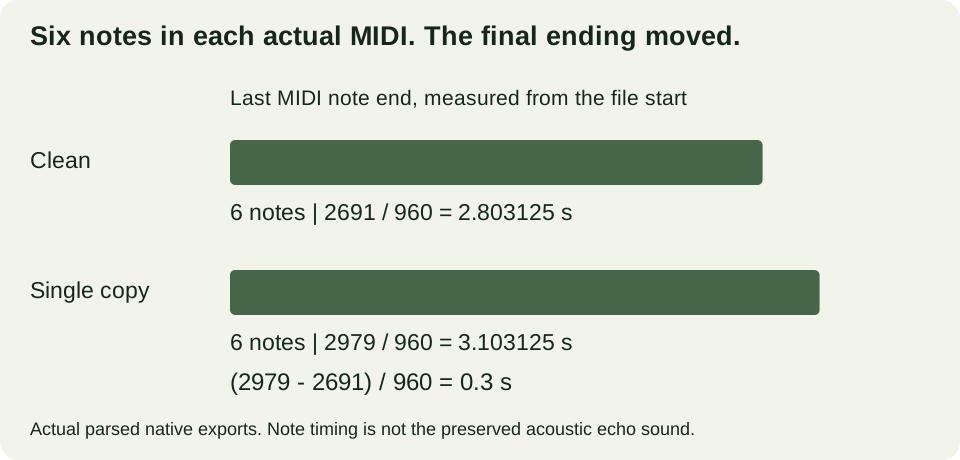
2.803125 s2691 ticks ÷ 960 ticks per second. This is an actual exported boundary, not the complete four-second file ending.
Single-copy echo
6 actual MIDI notes · 101 bytes
Last MIDI note ends
3.103125 s2979 ticks ÷ 960 ticks per second. This is an actual exported boundary, not the complete four-second file ending.
The clean last note ends at 2691 ÷ 960 = 2.803125 seconds. The echo result ends at 2979 ÷ 960 = 3.103125 seconds. Their difference is (2979 − 2691) ÷ 960 = 0.3 seconds in this pair. Neither boundary is the corresponding programmed layer ending, 2.86 or 3.16 seconds. The final note starts at tick 2296 in clean MIDI and 2385 in echo MIDI, so its longer duration is not simply the original duration plus the delay.
| Input | Key | Primary start (s) | Actual start tick | Actual end tick |
|---|---|---|---|---|
| Clean | 60 | 0.00 | 0 | 357 |
| Clean | 62 | 0.50 | 379 | 847 |
| Clean | 64 | 1.00 | 869 | 1315 |
| Clean | 65 | 1.50 | 1337 | 1806 |
| Clean | 67 | 2.00 | 1828 | 2274 |
| Clean | 69 | 2.50 | 2296 | 2691 |
| Echo | 60 | 0.00 | 0 | 424 |
| Echo | 62 | 0.50 | 468 | 892 |
| Echo | 64 | 1.00 | 936 | 1382 |
| Echo | 65 | 1.50 | 1382 | 1850 |
| Echo | 67 | 2.00 | 1895 | 2341 |
| Echo | 69 | 2.50 | 2385 | 2979 |
Compare timing against the primary melody
At the exported tempo, seconds = tick ÷ 480 × 500,000 ÷ 1,000,000 = tick ÷ 960. Programmed primary starts therefore correspond to ticks 0, 480, 960, 1440, 1920 and 2400. We pair by index because the two actual outputs have those same six distinct keys in order. We do not invent a twelve-note target for the acoustic components.
Absolute onset differences sum to 491 ticks for clean MIDI and 134 ticks for echo MIDI. Mean absolute onset errors are respectively 491 ÷ (6 × 960) ≈ 0.085243 seconds and 134 ÷ (6 × 960) ≈ 0.023264 seconds. Every actual event and subtraction input is retained in the raw record. The smaller onset value for this one constructed pair does not establish an advantage from adding echo, or from using this delay and gain on another recording.
What this check does and does not show
The observed echo input returned six note events, not a separate event for each copied tone. Its timing still changed. This does not show that an echo-removal stage ran: we did not capture intermediate detector frames, isolate an internal cause, sweep effect settings or test recorded rooms. The input also contains brief pitch overlaps, which belong in the interpretation.
Listen against the original before splitting, shortening or quantizing notes. A different playback instrument or an added playback effect is separate from the note events in the saved MIDI. Use the conversion tutorial for the selection and download steps. Added random noise and separate repeated attacks are different source constructions, not substitutes for this delayed-copy check. The current implementation is also available; reading it is different from measuring its intermediate state.
ORIGINAL ENGLISH EXPLANATION
Watch the delayed-copy comparison
The original source layers and saved MIDI boundaries, explained with synthetic English narration. Open the original video on YouTube.
Download the original pair and actual exports
Clean control
Compare the exact source with its real downloaded MIDI.
Clean control WAV Actual clean MIDISingle-copy echo
Compare the exact source with its real downloaded MIDI.
Single-copy echo WAV Actual echo MIDIRead the exact samples, hashes, MIDI events and arithmetic · Rebuild both original WAVs.
Questions about echoes and note events
Why did six copied tones not become twelve MIDI notes?
Editorial question. In this run the actual export contains six notes. The input has overlapping primary and delayed components, not twelve independent intended key presses. We have not isolated which analysis stage led to the returned event count.
Does the later final note mean that the echo sound survived?
Editorial question. It establishes a changed MIDI boundary, not preservation of the recorded sound. Compare the exact original audio with the exported note events and the instrument used for playback. No recorded-room result follows from this synthetic pair.