AUDIO TO MIDI / SAME MELODY, ADDED NOISE
Audio to MIDI with background noise
Check note identities and their boundaries separately when noise is added.
Measured answer. Both of our recordings returned the same six expected keys, but their actual MIDI timings differed. The noisy export even had a lower onset error under our stated comparison. That does not establish a reason to add noise. These are synthetic controls with one noise pattern and level, not a result for phone recordings.
Add noise to the same saved melody
We built one original six-note sine melody at keys 60, 62, 64, 65, 67 and 69, labeled C4, D4, E4, F4, G4 and A4 by Midilot. Programmed starts are 0, 0.5, 1, 1.5, 2 and 2.5 seconds. Each tone occupies a 0.36-second window, with a 0.01-second attack and a 0.06-second release inside that window. The remaining clean samples are zero.
Both saved files are mono, signed 16-bit PCM at 22,050 samples per second. Each contains 77,175 samples in 154,394 bytes, so duration is 77,175 ÷ 22,050 = 3.5 seconds. The last programmed tone window ends at 2.5 + 0.36 = 2.86 seconds; the complete file includes the later tail. These are constructed signals, not recorded musicians.
The second file starts with the already quantized clean samples. We add one deterministic integer noise value to every sample, including note gaps and the final tail. We do not synthesize a new melody, change its pitch formula or move its programmed note windows. The exact difference between the saved files is therefore available for an independent check.
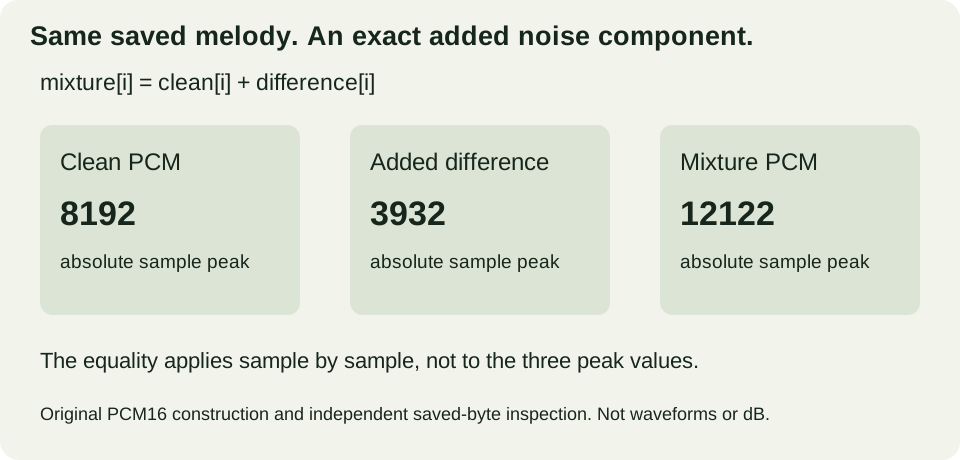
Verify the added component in the actual WAV bytes
The public generator begins with state 123456789. For each sample it updates state = (1664525 × state + 1013904223) modulo 4294967296, then computes noise = round((2 × state ÷ 4294967296 − 1) × 0.12 × 32767). The clean tone's amplitude coefficient is 0.25. These coefficients define this experiment; they are not measured recording settings or suggested gain values.
An independent Ruby reader checked both WAV headers, decoded every signed sample and subtracted clean from noisy. A separate bitmasked reconstruction matched every one of the 77,175 difference values. The raw record keeps the seed, formula and the first thirty-two difference samples, rather than calling the recording noisy based only on its filename.
Measured absolute PCM peaks are 8,192 for clean audio, 3,932 for the added difference and 12,122 for their mixture. No saved sample reaches either signed PCM16 boundary. The mixture was not clipped to create a louder example, and the clean samples were not replaced by independently rounded tones.
Whole-file RMS equals sqrt(sum(sample²) ÷ 77175). The clean squared sum is 1390862185543, giving approximately 4245.254498; the difference squared sum is 394483419424, giving 2260.872430. The mixture squared sum is 1781544372057, giving 4804.630598. These values are in integer PCM sample units and include gaps and the final tail. We do not present them as a microphone noise floor or a during-note measurement.
Both real downloads retain all six ordered keys
On 14 November 2026, we selected both WAVs separately in the production converter in Chrome. Export BPM was 120 and the clear-final-release estimate was enabled. Selecting the second file cleared the first result before conversion. Each run produced a new native MIDI download, which we saved and parsed independently with Ruby. We repeated both production conversions and native downloads on 15 November; both complete saved files and independently parsed events matched their original exports byte for byte.
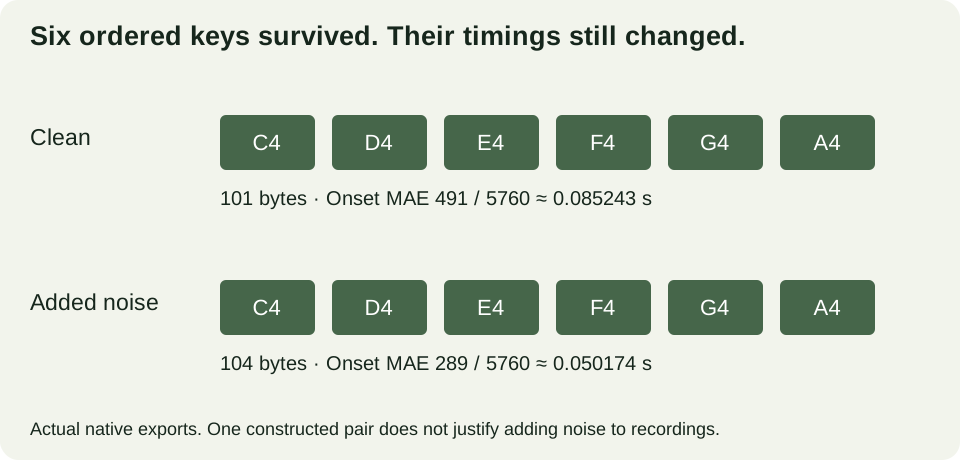
The clean MIDI contains 101 bytes and the noisy MIDI contains 104 bytes. Both have six notes in the original order: keys 60, 62, 64, 65, 67 and 69. Both are format-zero files with one track, 480 ticks per quarter note and one 500,000-microsecond tempo event. Every saved note velocity is 88. Matching the key list did not make the files byte-identical.
Clean control
6 returned keys- C4
- D4
- E4
- F4
- G4
- A4
Actual MIDI: 101 bytes. Onset MAE: 0.085243 seconds under the stated pairing rule.
Added-noise control
6 returned keys- C4
- D4
- E4
- F4
- G4
- A4
Actual MIDI: 104 bytes. Onset MAE: 0.050174 seconds under the stated pairing rule.
| Input | Key | Source start (s) | Actual start tick | Actual end tick |
|---|---|---|---|---|
| Clean | 60 | 0.00 | 0 | 357 |
| Clean | 62 | 0.50 | 379 | 847 |
| Clean | 64 | 1.00 | 869 | 1315 |
| Clean | 65 | 1.50 | 1337 | 1806 |
| Clean | 67 | 2.00 | 1828 | 2274 |
| Clean | 69 | 2.50 | 2296 | 2691 |
| Noise | 60 | 0.00 | 0 | 290 |
| Noise | 62 | 0.50 | 446 | 780 |
| Noise | 64 | 1.00 | 892 | 1181 |
| Noise | 65 | 1.50 | 1360 | 1761 |
| Noise | 67 | 2.00 | 1850 | 2229 |
| Noise | 69 | 2.50 | 2363 | 2675 |
The noisy result had a smaller onset error in this pair
We pair notes by index because both outputs have the same six distinct keys in the same order. At the exported tempo, seconds equal tick ÷ 480 × 500,000 ÷ 1,000,000, or tick ÷ 960. Source starts therefore correspond to ticks 0, 480, 960, 1440, 1920 and 2400. The JSON preserves every subtraction and absolute difference.
The clean output starts at ticks 0, 379, 869, 1337, 1828 and 2296. Its absolute onset differences sum to 491 ticks. Mean absolute onset error is 491 ÷ (6 × 960) ≈ 0.085243 seconds. The noisy starts are 0, 446, 892, 1360, 1850 and 2363, with a sum of 289 ticks and mean 289 ÷ (6 × 960) ≈ 0.050174 seconds.
The final notes also end differently: clean at 2691 ÷ 960 = 2.803125 seconds, noisy at 2675 ÷ 960 ≈ 2.786458 seconds. Neither is the 2.86-second programmed tone-window end, and neither should be compared with the complete 3.5-second file as if its entire tail were a keyed note. Count, onset alignment and release timing are separate observations.
What this comparison supports
The measured result is that this added component changed exported boundaries while the six ordered keys stayed the same. It does not establish that noise improves transcription: we tested one melody, one noise sequence and one level. We did not sweep different seeds or levels, capture intermediate detector frames, test noise-removal software or isolate a particular analysis-stage cause.
Keep the original recording and inspect the MIDI against it. If you compare processed audio, change one documented input at a time and check notes and boundaries separately. A valid file or a shorter timing error does not demonstrate a generally better transcription. The current implementation is available for inspecting how Midilot analyzes frames and writes notes; source reading is different from measuring its internal state.
Use the conversion tutorial for selection and export steps. A very quiet input and separate attacks at one pitch are different checks. Neither substitutes for this saved clean-plus-noise comparison.
ORIGINAL ENGLISH EXPLANATION
Watch the paired result
The original controls and actual saved exports, explained with synthetic English narration. Open the original video on YouTube.
Download the source pair and actual MIDI exports
Clean control
Keep each source recording beside its actual export.
Clean control WAV Actual clean MIDIAdded-noise control
Keep each source recording beside its actual export.
Added-noise control WAV Actual noise MIDIRead all PCM arithmetic, hashes, MIDI events and timing inputs · Rebuild the exact WAV controls.
Two questions before accepting a noisy recording
Do six correct note names mean the timing was preserved?
Editorial question. No. Both actual files retain six ordered keys, yet their starts and ends differ from the programmed reference. Inspect the complete event times alongside note identities.
Should I add noise because its onset error was lower here?
Editorial question. No such recommendation follows from this pair. A single seed and level do not establish a repeatable improvement. The recorded values describe these saved controls and the stated pairing rule.
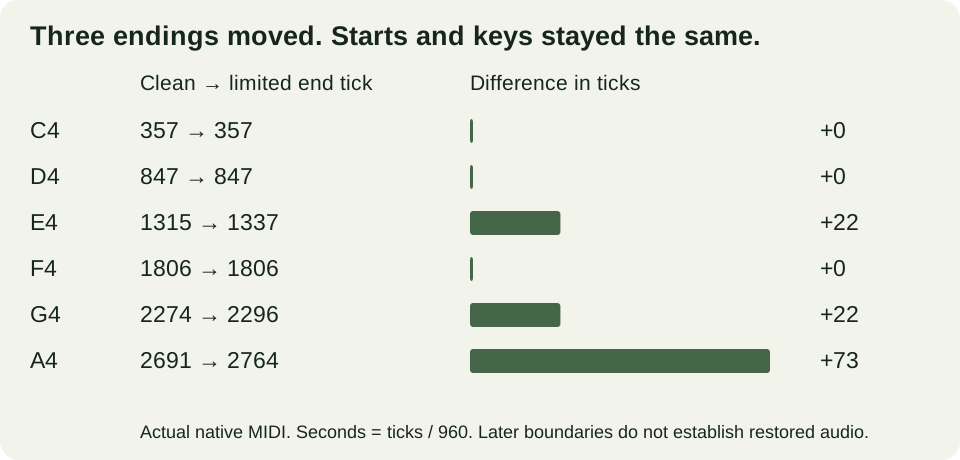
Inspect the exact clipped melody and actual MIDI endings.